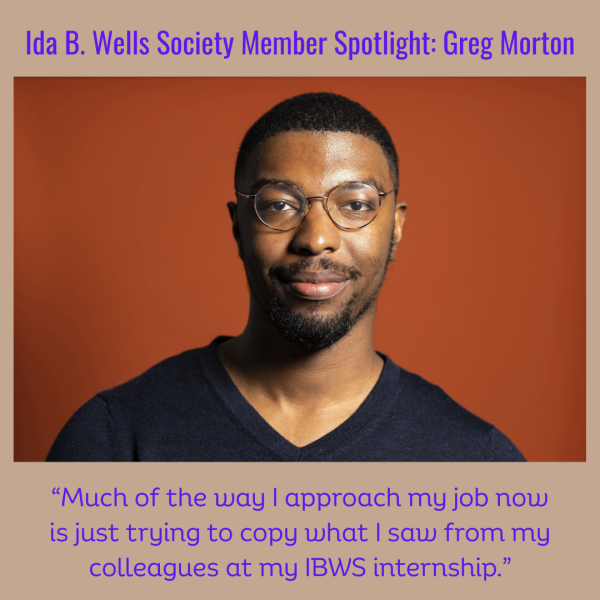
Greg Morton was one of the Ida B. Wells Society’s inaugural Investigative Reporting Interns in summer 2021. In the nearly five years since his internship at ProPublica, Greg has worked at The Washington Post, NPR, and The Baltimore Banner doing data journalism. Now, Greg is a data editor at The Banner.
He shared more about what he’s been doing and how the lessons from the internship have stayed with him.
What have you been up to professionally since your internship ended?
I’ve been really lucky to continue to work in journalism on accountability-focused stories. I started a fellowship program at the University of Maryland right after the internship wrapped up. During my time at UMD, I interned on the Washington Post’s data team and NPR’s “Planet Money.” I started my first full-time job as a data journalist at the Baltimore Banner in 2023.
While at the Banner, I have worked on investigations into the Francis Scott Key Bridge collapse, the Baltimore public school system’s failure to provide safe and reliable transit for students, severe racial disparities in Baltimore County traffic stops, and many other topics. Our work received an IRE Award in 2024, and I won the Philip Meyer Award for the best use of social science research methods in 2025. I was promoted to Banner data editor in 2025.
What was your introduction to investigative journalism?
Not to be too corny, but Nikole Hannah-Jones’ Choosing a School for My Daughter in a Segregated City was an important investigation for me. I always loved reading and journalism, but that piece was one of the first times I engaged with that kind of thoroughly reported and beautifully written story.
What has been your most impactful/memorable investigative reporting that you’ve worked on?
I learned a lot from working with legendary Baltimore education reporter Liz Bowie on our investigation of Baltimore’s bus system. The stories were an incredible chance to showcase what I could do as a traditional reporter and data journalist. The story’s data component gave me an excuse to try a lot of techniques for modeling and analyzing public transit data that hadn’t been used very often in journalism. I also got to work very closely with Liz, who was always a very gracious and collaborative story partner, on reporting the story out. I learned a lot from sitting next to her as we conducted interviews together.
What pushes you to keep going as an investigative journalist?
I genuinely enjoy the work! I feel very lucky to have a job where I get paid to learn about new things and explain what I have learned to our readers. I love applying creative problem-solving to overcome adversity.
What are some of the things you took away from your internship that still help you in your career now?
You can benefit a lot from your colleague’s knowledge and experience. I don’t think I realized at the time that I was working with some of the best journalists in the world. Put time on their calendars. Pepper them with questions. Ask about their approach to the job. Keep your hand up for assignments. Figure out what makes for a good story at your news organization and, if you feel comfortable, pitch stories! Much of the way I approach my job now is just trying to copy what I saw from my colleagues at my IBWS internship.
How has the Ida B. Wells Society impacted your work/career?
I really appreciate the mentorship and advice from the founders and guest speakers we worked with during the internship. I also felt really cared for and invested in after the internship ended. I still send Topher (Sanders, Society co-founder) my investigations when they publish.